Knowing our place


moonflag.jpg
2016 is an presidential election year, and that means candidate debates.  On the GOP side, I’ve been watching efforts to capture the coveted ‘Evangelical’ vote.  The debates provide a high-profile soapbox for Republican wannabees to profess their commitment to protecting the Christian values of our country and turn back the tide of cultural demons and religious infidels that threaten them.  To be a serious Republican candidate, you have to have a plan to restore God’s destiny for America in your platform if you expect to win. To show their Evangelical audience that they are in tune with the Lord’s will for our planet, we’ve heard candidates commit to carpet bombing Islamic infidels back to the Stone Age, and instituting (or removing) laws that will rebuild our lost Christian family values.

Thinking about this as I was flipping through TV channels one night, I landed on a documentary that was discussing the vastness of our universe. A scientist was providing an interesting perspective on how massive our universe is. He stated that our Milky Way galaxy has over 200 billion stars in it, and that astronomers have estimated at least 500 billion galaxies in the universe. Multiplying those together, that’s a whopping 10,000,000,000,000,000,000,000 or 1 sixtillion stars like our sun in the universe. To picture this, he said to imagine standing on the beach with a single grain of sand on your fingertip. That’s our sun. Then imagine the grand total of every grain of sand on every coast around every continent around the world. That’s how many stars are out there in the universe, give or take a few billion. All of it God’s creation. All of it so much bigger than our little round rock sitting next to one of those grains of sand. I turned off the TV and just sat there, humbled.

As I thought about that over the next week, I also wondered about the other half of the time-space continuum. Where do we as humans sit in God’s concept of time? A little Google research revealed that most scientists believe the first signs of life, basic organisms called prokaryotes, appeared on our planet about 2 billion years ago (apologies to you creationists out there). Now, to follow my scientist friend’s attempt to simplify this, imagine a single calendar year where prokaryotes show up on Jan 1 at 00:01 and our current moment in time is December 31st at 12 midnight. This would put the first man (defined as the genus homo-) on the earth Dec 31st at around 6:15pm. Just in time to start celebrating New Year’s Eve.

Did you get that? We, as God’s crowning achievement, are just a blip in his universe and almost rounding error in the creation timeline.

Here’s my issue -When those of us on this little speck who just recently showed up to God’s party believe that we can take it upon ourselves to judge and interpret every perceived threat to God’s plan from our (relatively) small-minded perspective, I think we’re treading on ridiculous, and dangerous, territory.

As far as I know, we’re not told to fight the gay agenda, to curb the influence of Islam, or to restore prayer in schools. The mightiest force in an unfathomable universe can manage those things on His own in His time.

What am I told to do?

Love.

Love God with everything I have and love others as much as I do myself. That’s the only responsibility the creator of this vast cosmos felt I needed to follow. I wonder what our nation would truly be like if our evangelical leaders would focus just on that?
Storytelling done right

In a previous post, I talked about storytelling that is compelling, yet still ownable by the brand.  Always’ “Like a Girl” was an example of this well done.  Unfortunately, not every brand is in a position to own a cause like Always has.  Can parent brand advertising build equity for the overall line without product news when there is no cause-related message?

In general, brand equity advertising is tough.  I almost always lean towards the ‘hero and halo’ approach – hero product news that delivers against an unmet consumer need in a compelling way, and let it halo over the rest of the brand.  This is especially true with the use of TV, where you only have 15 or 30 seconds to get your message across.  Tough to tell a story in this short time frame, and longer spots are very expensive to air and rarely hold today’s short-focus consumers long enough to get through the ad in a commercial break.

The digital explosion has changed the game here, though.  Video for the internet is less expensive to air, and the integration across platforms allows marketers to lead target consumers to the message easily and effectively.  Now, brands have the capability to tell a longer more in-depth story that can develop the personality and equity of the brand.

That still leaves the issue of developing an engaging message.  Content is much more of a focus, and having the time doesn’t often translate to time well spent.  The time-tested measures of good copy still apply in this new space:

  1. Is the message compelling?  Is the communication mind- or heart-opening for the viewer?  Does it challenge assumptions or create an emotional attachment for the viewer?
  2. Does the message reward the viewer?  Was it done well enough to create a positive experience for the target that holds their attention through the entire message?
  3. Is the drama about the equity message?  Does the creative reflect the point of the advertising and highlight the benefit?
  4. Is the communication ownable?  I think this is the biggest gap in producing good copy.  I have delivered advertising that drove great interest, but no one could recall what is was for.  Does the message reflect directly back on the equity of the brand?

So, who’s doing this right?  Hershey has recently moved to a master brand vs. product approach.  I think that their first execution out of the gate does a good job of delivering against the above criteria, and the result is a great piece of storytelling that builds the Hershey equity:

https://www.youtube.com/watch?v=x5jeP4Ftp0Q


In defense of the new PSU logo

As both a Penn State grad and a marketer, I watch the recent controversy over the new PSU logo like an athlete-turned-sportscaster announcing a game with his former team.  You need to be objective, but there are emotional pulls that are neither objective or even rational.

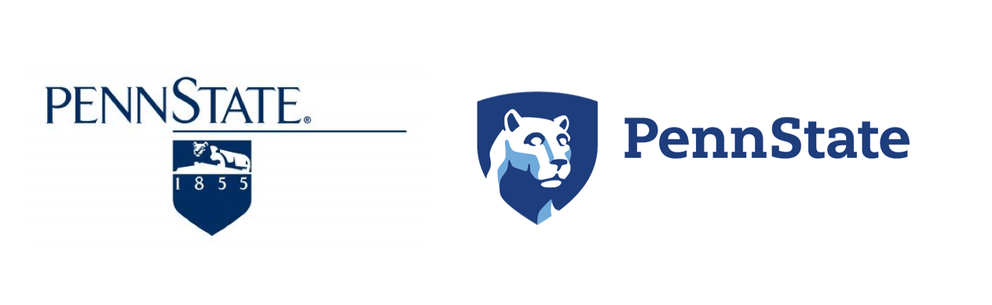
For those of you not aware, earlier this year Penn State revealed the new school logo, replacing the current design which had been in place since the early 80s.  Below is a comparison of the old (left) and the new (right).
penn state logo comparisonThe reaction from alumni has been swift and sharp, especially on social media.  A couple representative posts:

It’s bloody awful. If they were going for an app icon, they got it. It’s generic and fails to evoke any sense of heritage or tradition. The blue is effete and the lion looks like the Pink Panther.”

“This logo is embarrassing and pathetic. Please return to the old logo and please request a refund for the design of this amateurish logo.”

“Saw the new logo going up a sign at a new Penn State Health facility this week. New logo doesn’t look any more professional in a life size setting than it did when first unveiled on the internet. It will probably grow on us; but then again so would mold.”

“Penn State paid money for this logo? Yikes.”

Wow.

The response has been uglier than when the university unveiled the hapless ‘Penn State Lives Here’ tagline.  Although I agree that PSLH is pretty much useless, I feel good about the new logo for a couple of reasons:

  1. It’s more accessible.  The lighter color, the softer font, and the lion shrine are all more approachable than the stiff and stoic logo of the past.  In an era of rising tuition and limited opportunities after graduation, prospective students are looking even more closely for a school where they feel they can fit in and succeed.  Having a key visual that is more welcoming makes a great first impression.
  2. It better fits with Penn State’s ‘hands on’ equity as a university.  Penn State defines it’s graduates as ‘inspired doers’.  In my own experience, my Penn State hires tended to acclimate to the work environment faster, get involved more quickly, and form some of the strongest relationships on the job.  Penn Staters aren’t about image, they’re about substance.  A simple ‘everyman’ type logo fits well with this reality.
  3. It better reflects the informal lifestyle of today’s prospective students.  When was the last time you saw Gen Z’ers in anything besides shorts and t-shirts at an event?  Many don’t even own a tie, let alone a suit.  Same thing with their communication – abbreviations, simplified spellings, and text-driven phrasing ignores most of the formal rules taught to them in English class.  This generation doesn’t know formality, and this logo doesn’t either.
  4. It works harder to communicate the global brand in communication, freeing up the majority of creative space for target-specific messaging.  In the end, the question is not one about feeling as much as it is effectiveness, and this is where I think the new logo shines.  An example to make my point: compare two pages on the Penn State website, one that has made the conversion and one that has not:


psulaw


psueng

The Law School site still uses the old logo.  If the objective of the university is to strengthen it’s global brand across its programs (and it is), the global branding here gets lost on the page.  Is this Penn State?  You have to work to figure it out, including using other cues on the page besides the global brand mark, cues which takes up valuable viewable screen space for college-specific communication.  On the other hand, the Engineering page with the new logo makes this much clearer.  The logo uses the same real estate as on the Law page, but the Penn State brand moves  waaaaay up in priority of communication.

The new logo is a significant change, especially for those who have been around for all of the life of the old one.  Could I tweak it?  Yes, but the fundamentals are fine.  The critic is right, we’ll get used to it.  But this is a far cry from mold.

One other point – the other ‘new’ logo that came out in the ’80s was the athletic mark.  The reaction here was swift and negative as well – loss of tradition, too hard to grasp, looks more like the Nittany Chipmunk.  And it’s legacy?  It has consistently ranked in the top five of ‘best college logos’ across a wide range of surveys and media outlets.

Not all change is bad.


Branded Storytelling

Storytelling has become a hot topic for brands that are trying to create authentic connections with their consumers.  The viral nature of digital communication enables good storytelling to capture millions of eyeballs at a low cost.  The benefit of developing heart-opening messages that create an aspirational tone for what the brand stands for is big – the brand moves from being a product or service to being a force for good in an area that is important to the target.  Consumers form a relationship with the brand, united in what the brand equity is trying to stand for.

However, many brands focus on creating formulaic stories that are focus group-tested to deliver a heart-tugging emotional response, but fail to demonstrate why the messaging is relevant to the brand.  In most cases, they succeed in generating the expected tears, outrage, or laughter from the viewer.  Unfortunately, the messaging often fails to tie back to an ownable equity for the brand, and the consumer leaves emotionally charged but clueless to who the message represents or why.

A couple of examples can make this evident.  Below is a well-known storytelling effort by Always that leverages an insight regarding changes in self-image in girls at puberty, exactly the moment where Always becomes part of the decision set for a young girl’s new needs.  By championing confidence in young women at the moment where they and their parents are both open to this message, Always successfully creates a strong, positive image for the brand among their target:


Quaker Oats tried a similar tactic, leveraging an insight regarding the difficulty for working fathers to engage with their daughters. The ad delivers the expected result – an emotional feel-good reponse to a story of father-daughter bonding:

Unfortunately, the brand plays almost no role in the messaging, and nothing in the story ties back to anything within the Quaker brand equity.  The consumer is left with a five minute Hallmark movie with a brand name randomly slapped on it.  This could have easily been a message for Danskin or even Verizon.  Quaker would have been better off buying the pre-roll ad for an established viral video – they could have delivered more impressions and saved the production costs.

Storytelling is a fantastic way for brands to take consumers on a journey with them that can form strong bonds that go beyond product benefits.  However, if the messaging isn’t ownable and relevant to the brand’s equity, the brand will get lost amid the tears.